
Queering the Phenomenology of the Body in Photographic Depictions of Lesbian Domestic Utopia
written by Dominique Park
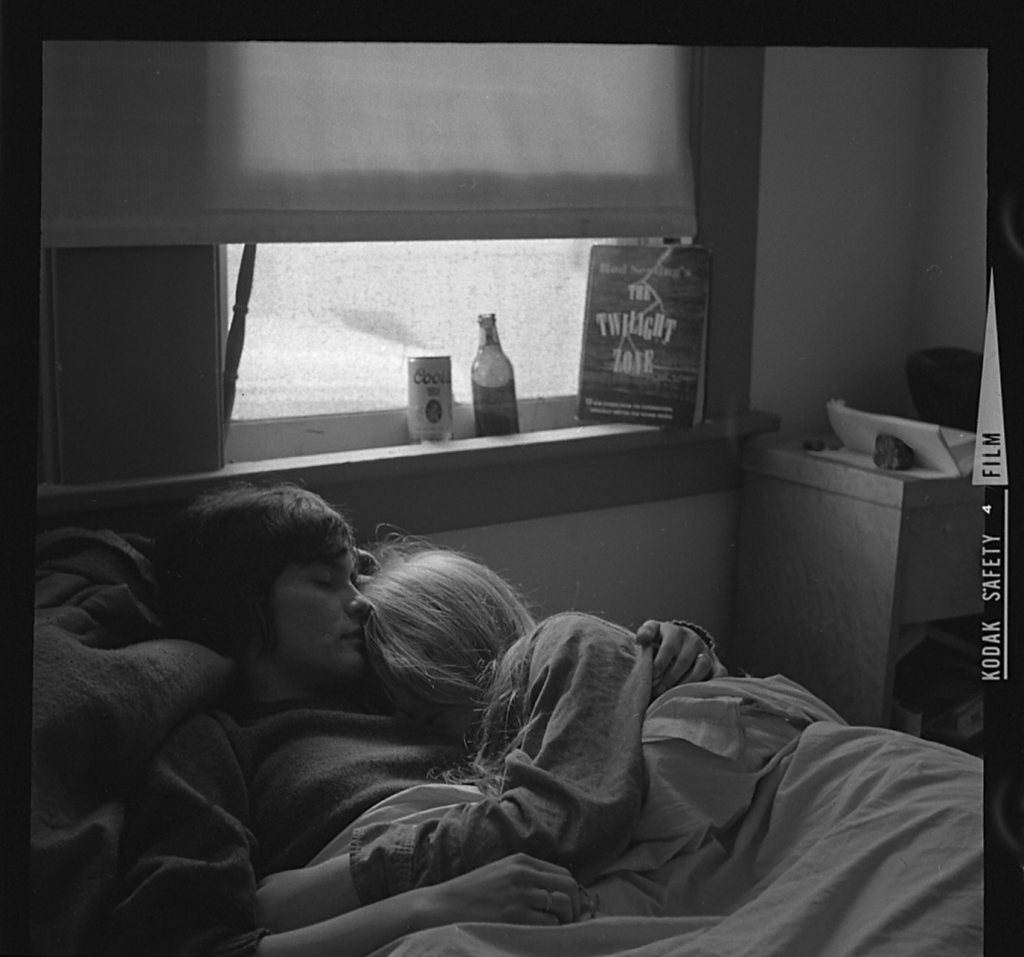
One of art’s social purposes is to present utopias. Queer art can be something that shows queer utopias. It can offer unconventional ways of connecting and being. It can present a world where queer visibility does not have to be confrontational, to fight for fundamental human rights, or illegible to avoid persecution.
Erkki Sevänen, 2018.1
The domestic sphere has long been a rehearsal space for futures not yet within reach. It is specifically queer art, conceived within the confines of one’s home, that gestures toward a mode of existence just outside of the perimeters of mainstream acceptance. In photographing lesbian homes, artists Barbara “Bee” Ottinger, Catherine Opie, and Rina Mintz visualise spaces where lesbians could collectively imagine a space blanketed by the intimacy that normalcy offers. By utilising the privacy of the domestic, their works transcend the need for overt confrontation, remaining legibly queer to reveal how homes offer a unique comfort that unlocks utopic potential for the lesbian community. With the portrayal of queer domesticity and the importance of visibility as the throughline, this analysis traces how visibility for the lesbian community has developed in tandem with the state of sociopolitical progress in the United States, from the 1970s to the present day.
Queer theory and photographic theory converge in this examination, primarily unpacking ideas brought to light by Sarah Ahmed and Roland Barthes. Ahmed’s book, Queer Phenomenology: Orientations, Objects, Others, considers how sexual orientation affects the way queer bodies inhabit and move through space.2 To complement Ahmed, this examination employs Barthes’s idea of the punctum—the detail of a photograph that “pricks” or “bruises” the viewer3—and his concepts surrounding photographic indexicality in his book Camera Lucida.4
Unfolding chronologically, this analysis inspects frame #18 in series III, sleeve 04A (see Fig. 1), of Ottinger’s Lesbian House series (1972–1973), produced in the midst of the lesbian separatist and radical feminist movements in Los Angeles. Twenty-five years on, we encounter Opie’s photograph, Eleanor and Megan (see Fig. 3), from her Domestic series (1995–1998), where visibility itself became a radical assertion of legitimacy and futurity. Finally, another twenty-five years later, we examine Rina Mintz’s collaboration with prominent social media figures, Izzy Perez and Emma Fuente (2024) (Fig. 4). This reconfiguration of lesbian domesticity through the infinite visibility offered by digital platforms reframes the domestic sphere as a shared utopia, embodying the radical potential Ottinger and Opie had once hoped for. However, the pursuit of queerness remains a continuous, necessary endeavour: an endeavour that urges us to imagine beyond present limitations and to see in each act of visibility, the glimmer of a world yet to be realised.
Domestic spaces, particularly queer domestic communes, nurture the “counterpublic.” Michael Warner delineates the “counterpublic” as an arena where a subordinated group, typically formed at the margins of normative hegemony, acknowledges their subaltern position and proceeds to express ideas or enact behaviours that would otherwise be met with hostility by the general public.5 The little-known Lesbian House of Los Angeles—captured by Ottinger for her thesis project—is one of the most remarkable instantiations of a successful, albeit short-lived, counterpublic domestic commune. In a 2010 interview, Ottinger recounts that the house was leased by an unnamed woman who had inherited a substantial sum of money, and, given her rough coming-out experience, wished to ameliorate some of the same pain for other lesbians in the community.6 Any lesbian who needed a home in Los Angeles was accepted, irrespective of age, race, or class.7 Over 1,500 negatives from the Lesbian House collection are digitised through Middlebury Special Collections; however, without the formal publication of this series, this collection remains relatively unknown and unseen.8
In the same interview, Ottinger reminisces on her time at the commune, repeatedly invoking the house as the locus in which she not only learned of her own lesbianism, but also witnessed other women exploring their innermost curiosities, those of which they had once rendered inexpressible.9 For many women, the privacy and domesticity that this enclave had afforded them constituted a utopian state: a site in which one could freely express their romantic adoration for their partner and imagine a queer future for themselves outside of the dominant structures of heteronormativity.
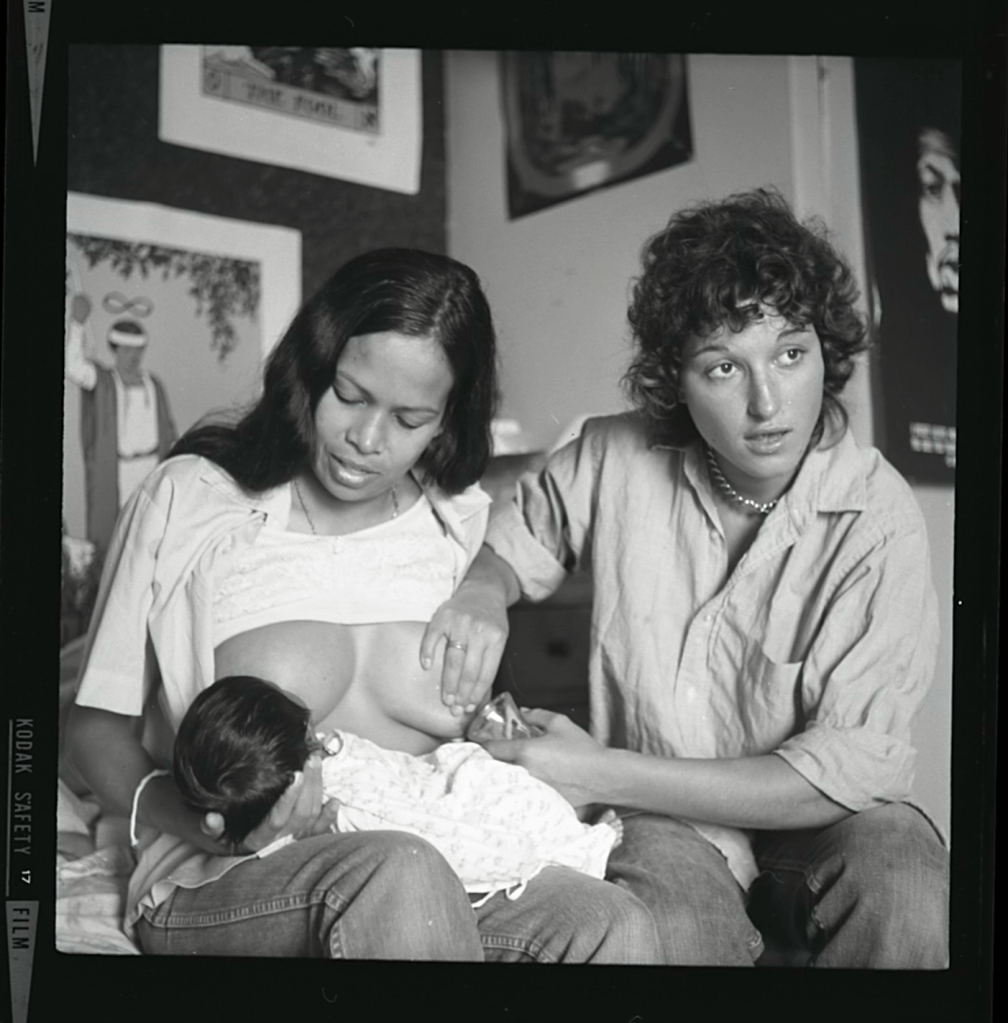
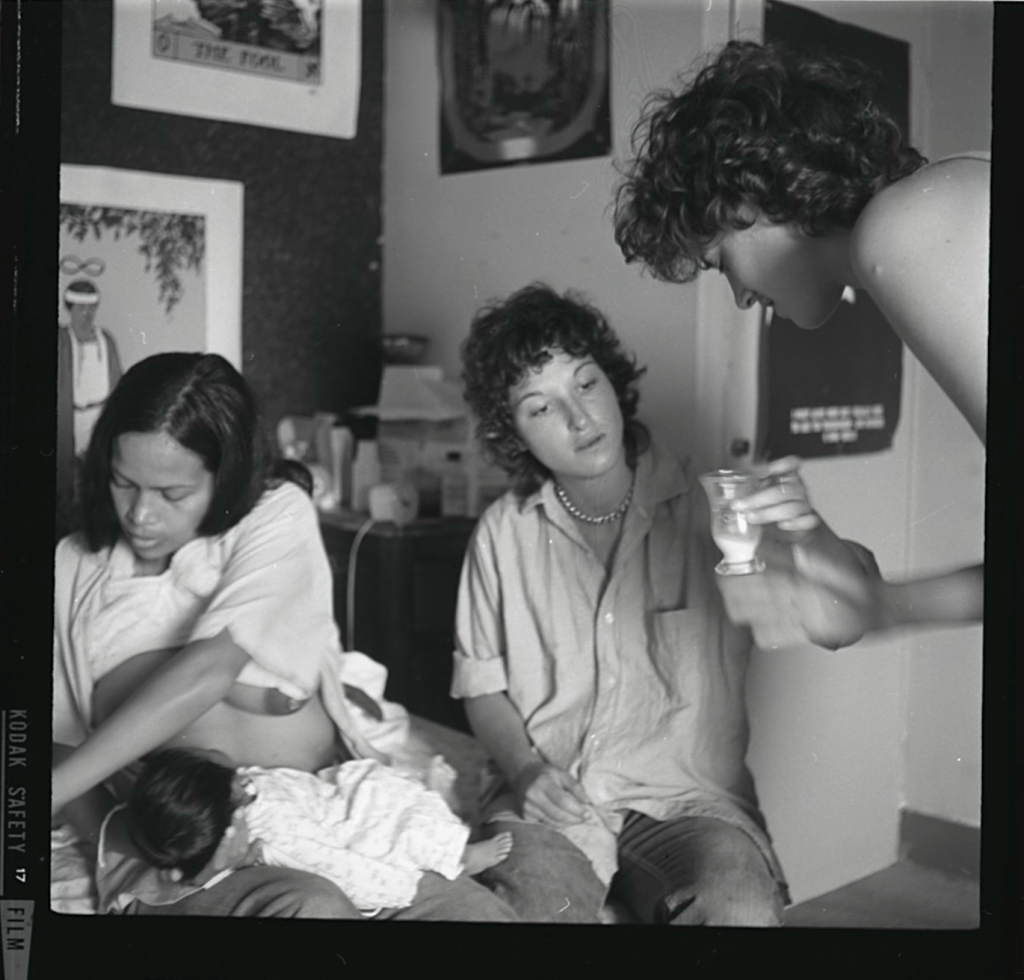
In imagining potential queer futures, some lesbian couples envisioned family making as central to their utopian state. This ethos coincided with the lesbian feminist movement’s aspirations to redefine what constituted a family unit in the face of intense, brutal scrutiny against lesbian families.10 Between 1972 and 1973, the house welcomed a newborn within its walls. Encapsulated within a single frame of a Kodak 126-format negative is the pinnacle of community, lesbian domestic utopia, and second-wave feminist consciousness in the United States (see Fig. 1). In this frame, the non-birthing mother assists her partner by manually expressing breast milk into a small cup. Her gaze is directed beyond the frame, implying the presence of others, and this inference is confirmed by the frame above it (see Fig. 2), where she is pictured handing the cup to another woman. This offer of breast milk to this woman—whether interpreted as practical, symbolic, or merely experimental—embodies the permeability of kinship structures that existed in the house. This small act dislodges the singularity of biological motherhood—affirming care, corporeality, and interdependence as communal acts within the feminist domestic counterpublic.
The punctum resides in the exposed breast and the rhythmic pressure of the other woman’s hand, a gesture that unveils an unguarded intimacy that makes the photograph pulse with tenderness. Ottinger’s formal precision in tightly framing the family enhances this affective immediacy; however, it is her privileged access to this profoundly intimate moment that resonates most deeply. As Michel Foucault proposes, “to be gay is not to identify with the psychological traits and the visible masks of the homosexual, but to try to define and develop a new way of life.”11 The kinship and sense of community that blooms from the “homosexual mode of life” conjure a relational ontology that has long resisted institutional codification.12 This way of life encompasses subcultural practices and alternative modalities of community, orienting their members toward a domestic utopia as they consciously sought fulfilment and joy in forms that would have disrupted dominant norms.13 The documentary photograph, in its indexical and mnemonic capacities, lends a sense of verisimilitude to the scene. Linda Zhengová claims that this sense of realism carries the potential to instil an affective relationship between the viewer and the object.14 Through this relationship, the artwork no longer embodies a “merely visual representation but rather comes into existence in the mind of the viewer,” directly placing us within the events of this tableau.15
Given the density of affect in the image’s foreground, the subtleties embedded within the background may easily evade perception. Yet, as Ahmed states, “the photographs are objects on the wall. They turn the wall into an object, something to be apprehended; something other than the edge of the room.”16 In Ahmed’s words, photographs, particularly family photographs, act as objects of the heterosexual gift, securing belonging through inherited domestic display, making visible a fantasy of “the good life.”17 However, when inspecting the interior of this room, we encounter not a family portrait, but a poster of The Magician tarot card. During the 1970s, specifically within lesbian separatist and radical feminist circles, there was a surge of popularity in tarot.18 Not only did tarot penetrate these movements through covert action, but its perception in popular culture helped transform tarot into an inherently feminine spiritual tool that allowed women to reclaim forms of knowledge that had historically been dismissed by patriarchal structures.19 This poster thus fills the absence of familial imagery, transforming the wall into a site of alternative intimacy where spiritual and communal refuge gestures toward the utopic potential of lesbian domestic life. It is admittedly both idealistic and poignantly hopeful to imagine a future for this family wherein this negative might have been developed, printed, and perhaps framed on their own wall, thereby transforming it into an object of life, a gesture of love, and a tangible manifestation of their own “good life”.
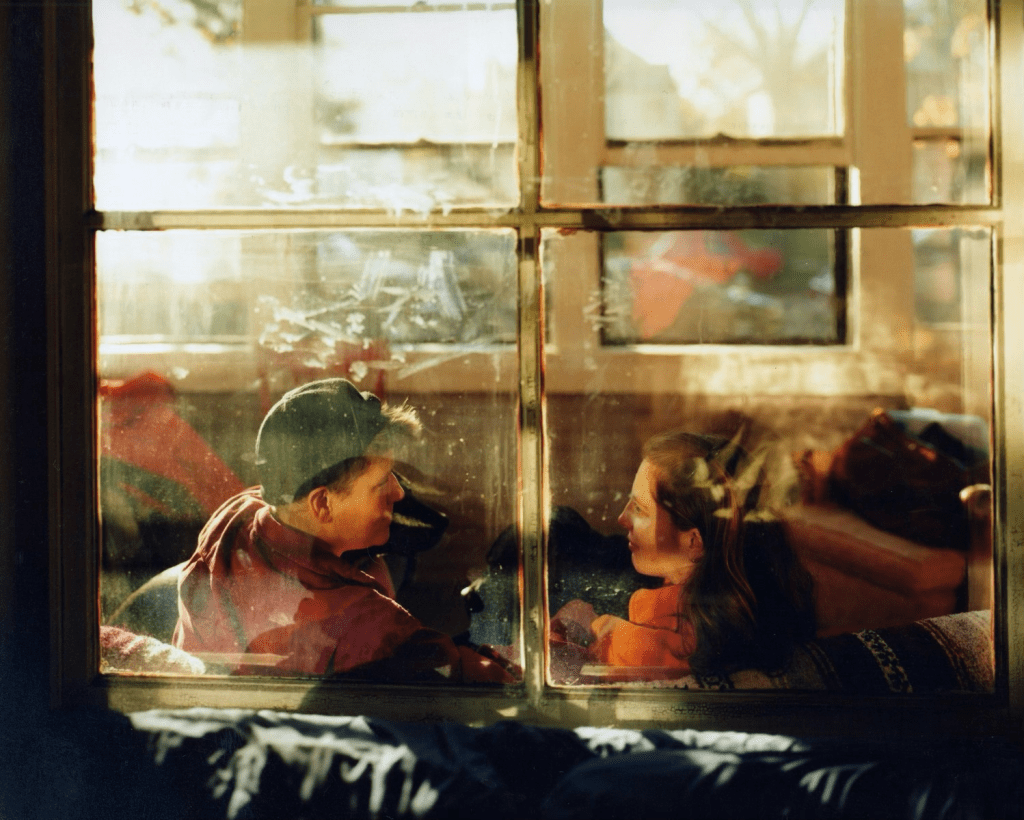
If Ottinger’s photographs of the Lesbian House visualise a collectivist utopia created through domestic intimacy, then Catherine Opie’s Domestic series reconfigures that same utopic impulse within the framework of 1990s visibility politics. This collection of photographs transpired as a response to the lack of queer imagery in the 1991 Pleasures and Terrors of Domestic Comfort exhibition at the Museum of Modern Art in New York.20 Thus, in 1998, Opie completed a nine-thousand-mile journey across the United States, photographing lesbian families and couples in their homes.21 In an interview, Opie states that she wanted to construct these photos of lesbians in their homes as a means of confronting the scarcity of media foregrounding lesbian domesticity in the 1990s art scene.22 In addition to the denial of lesbian legitimacy in the cultural scene of America, lesbian relationships were denied legal legitimacy. This series was shot just two years after the Defense of Marriage Act—the federal law that recognised marriage as a union between one man and one woman—was passed in 1996.23 Within this context, the simple act of being seen, and of looking back, assumed a quiet yet radical significance.
Forgoing any bodily contact, it is solely the gaze that Eleanor and Megan share that captures the almost tangible level of affection they possess for one another, and this is enhanced by Opie’s construction of the scene. Opie’s tactical decision to stage the photograph from outside of the women’s confined space both disarms and implicates audiences upon viewing. The women in the photograph are framed by a windowpane as the faint reflection of warm sunlight scatters softly across the glass. The sunlight reflects the window, not only accentuating traces of tactility and habitation—the fingerprints—but also heightening the sense of separation between interior and exterior worlds through multiple frames. The subtle transition from Ottinger’s enclosed interiors to Opie’s inclusion of several exposed windows into the outside world signals a substantial shift—visibility is beginning to edge toward the broader public. The window becomes both an optical and metaphorical threshold, forcing the viewer to look both in and out, while simultaneously revealing a world within the subjects that is intimately self-contained. The reciprocal, tender gaze between Eleanor and Megan transforms the domestic space into a site of emotional plenitude. Their intimacy is made visible through the minutiae of shared domestic life.
In the hope of not being reduced to a person who does not dream of stepping into “something fuller, vaster, more sensual, and brighter,” as José Esteban Muñoz describes, a clarification concerning the risk of the normalisation of lesbian domestic life must be articulated.24 The subject matter and context of Opie’s Domestic series have inevitably led to the exclusion of her photos from discussions surrounding lesbian representation for fear that they might be read as attempts to normalise lesbian domesticity.25 Therefore, it must be emphasised that this series is not about basing lesbian domestic imagery on a heterosexual model, but that it is about documenting the lesbian community, for the lesbian community. Opie’s contributions to queer world-making, contrary to critics’ beliefs, carve out spaces for collective longing and supply fuel for the lesbian community to remain hopeful for a future with a semblance of normalcy.
This sense of hope, intimacy, and looking is central to Opie’s own analysis of the Domestic series. In an interview, Maura Reilly questioned Opie about the slight element of sadness in the images.26 In response, Opie admitted that, “Many of the images are suffused with longing. A lot of this is about my own desire.”27 The photograph then, in a sense, becomes a double portrait: of the subjects, and of Opie’s yearning for her own domestic utopia. The longing imbued into this photograph resonates with Muñoz’s notion of queer utopia as an “anticipatory illumination,” which he describes as a glimpse into a world not yet realised, yet perceptible through fleeting moments of touch, gesture, and intimacy.28 Eleanor and Megan, and the Domestic series as a whole, are delicately suffused with this anticipatory affect: they are images of the present haunted by the potentiality of a fulfilling, free future.

Twenty-five years on, New York-based photographer Rina Mintz rearticulates Ottinger and Opie’s pursuit for visibility through her use of portraiture, her choice of location, and her collaboration with well-known lesbian personalities. Pictured on their fire escape, the outermost edge of their New York City apartment, social media figures Izzy Perez and Emma Fuentes stand poised, exhibiting their affection for one another. Blurred by the warm hue emanating from the interior of their home, Mintz utilises the intimacy of the medium shot to capture Izzy and Emma gazing into the camera. Departing from the documentary style of photography that Ottinger and Opie used, Mintz turns to portraiture as a mode of self-determination. This shift pries beyond aesthetic evolution but is deeply sociopolitical, speaking to the relationship between visibility, agency, and risk in lesbian life; a relationship that has drastically changed from the 1970s to the present day. In the wake of marriage equality, Mintz photographs from a position where lesbian relationships have gained a measure of social and legal legitimacy—still politicised, yet no longer confined to the secrecy that the interior domestic space lends. Mintz’s photograph of Izzy and Emma on their fire escape encapsulates this societal progress both symbolically and literally. The fire escape, an equally ubiquitous and liminal feature of the New York apartment, is the threshold between interior safety and public exposure.
It also functions metaphorically as the boundary between the freedoms afforded to lesbian couples in the aftermath of marriage equality and the renewed precarity that flooded the queer community under the Second Trump Administration’s rollback of LGBTQ+ rights. In an interview with UCLA Radio, Izzy Perez stated that in the face of such sociopolitical peril, she feels the need to continue to be visible and not to stop posting, as she views persistent visibility as a small act of protest.29 In highlighting the defiant undertones of this photograph through its setting, Mintz also envisions utopia as a state of ease: one in which lesbian existence is no longer solely visible for the purpose of defiance, but is quietly self-assured. This partial enfranchisement allows her to capture moments where her subjects are able to, as Ahmed claims, extend themselves into spaces which entail extending what is familiar or within reach, such as domestic spaces on the precipice of the public sphere.30
The orientation that Izzy and Emma have been drawn toward reflects ideas voiced by Ahmed about how one’s sexual orientation dictates how they might experience or reside in space, as well as “who” or “what” the spaces are inhabited with.31 This outward orientation toward a space that is not within the confines of the interior of the home, but is completely visible and susceptible to criticism from the viewing public, is a direct reflection of the liminal space that American queer politics occupies at the present moment. The fire escape, therefore, becomes not only a metaphorical prop in the mise-en-scène of this photograph, but also a phenomenological hinge between the private and public spheres. Utopia, therefore, shows up not through retreat as it did for Ottinger and Opie’s photographs, but through an expansion into spaces and through the freedom of visibility: to be seen together and to circulate one’s image to millions of people without fear.
This infinite circulation also highlights a new dimension of queer spectatorship and dissemination that the medium of photography has enabled. Due to the sheer volume of their followers (two million followers across Instagram and TikTok), Izzy and Emma have acquired multiple active fan accounts. One such account posted an appreciation edit (see Fig. 4) with the caption reading “visibility is lifesaving. thank u izzy and emma for providing a safe space for people to be themselves…” with the most liked comment under that post reading “queer media highkey saved my life.”
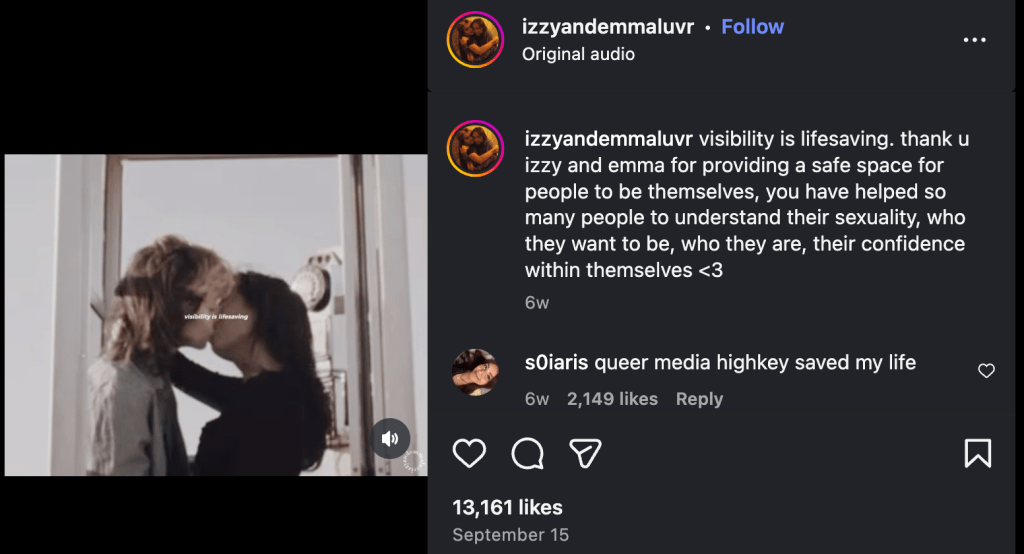
This appreciation speaks to the immense affective resonance of their presence on social media and their success in cultivating digital counterpublics. In this context, Mintz’s photograph becomes an affective conduit through which identification, survival, and futurity are negotiated, transcending beyond means of representation.
It goes without saying that the indexical quality of photography plays the most important role in the realm of visibility for queer people because, unlike a painting or drawing, the photograph is a literal emanation of what was. Drawing from Barthes’ notion of indexicality, photography functions as the physical imprint of a scene that once existed, a sort of ‘umbilical cord’ that links the referent to one’s gaze.32 This use of photography as evidence of existence spotlights the effectiveness of photography as a medium in bridging the gap between visibility and invisibility. Coupled with the pervasive presence that is social media, each seemingly inconsequential interaction a viewer has with queer imagery becomes a reiteration of existence. In this way, Mintz’s use of social media portraiture transforms a once static representation of a lesbian utopia into a living, circulatory archive of survival and imagined queer futurity.
Although the domestic sphere is a universally recognised space for comfort, queer folk have, throughout time, looked to it as a site of possibility. From Ottinger’s tender capture of collective lesbian kinship in the 1970s, to Opie’s quiet assertion of visibility in the 1990s, and finally, to Mintz’s digital reconfiguration of domesticity in the present day, each artist reflects the capabilities of their time in both documenting and imagining lesbian domestic utopias. In queering the phenomenology of the body, Ahmed reminds us that sexual orientation directly impacts the way that queer bodies navigate space—in the domestic sphere and at the margins of it. Across these three artists and their photographs, the significance of Barthes’s notion of indexicality becomes evident in how photography operates as both evidence and affect. The medium’s indexical trace renders it invaluable for queer representation as the direct relationship between photography and queerness—realism and idealism—lends lesbians an avenue through which they can envision utopias within the realm of the present and into the future.
As José Esteban Muñoz remarked:
Queerness is an ideality. We may never touch queerness, but we can feel it as the warm illumination of a horizon imbued with potentiality. We have never been queer, yet queerness exists for us as an ideality that can be distilled from the past and used to imagine a future.
The future is queerness’s domain.33
𓇢𓆸 References 🀦
- Erkki Sevänen, “Art Self-Criticism of Modern Culture and Society,” Lecture Series, University of Helsinki, 2018.
- Sarah Ahmed, “Introduction: Find Your Way,” in Queer Phenomenology, (Duke University Press, 2006), 1, https://doi.org/10.1215/97808-22388074001.
- Roland Barthes, Camera Lucida: Reflections on Photography, trans. Richard Howard, Vintage Classics (Vintage, 2000), 27.
- Barthes, Camera Lucida, 80.
- Michael Warner, Publics and Counterpublics (Zone Books, 2021), 112, https://doi.org/10.2307/j.ctv1qgnqj8.
- Bee Ottinger Lesbian House Interview, directed by Barbara “Bee” Ottinger, 2010, http://archive.org/details/c-71_bee-ottinger_interview_2010, 00:43.
- Bee Ottinger Lesbian House Interview, 01:27.
- “Internet Archive: Lesbian House Photographic Negatives by Barbara Bee Ottinger,” https://archive.org/search?query=source%3A%22C71%22.
- Bee Ottinger Lesbian House Interview, 14:56.
- Victoria Clarke, “From Outsiders to Motherhood to Reinventing the Family: Constructions of Lesbian Parenting in the Psychological Literature — 1886–2006,” Women’s Studies International Forum 31, no. 2 (2008): 121, https://doi.org/10.1016/-j.wsif.2008.03.004.
- Michel Foucault, “Friendship as a Way of Life,” interview by René de Coccatty et al., trans. John Johnston, April 1981, in Foucault Live Collected Interviews 1961-1984, (Duke University Press, 2004), 310-311.
- Foucault, “Friendship as a Way of Life,” 309.
- Linda Zhengová, “A Resistance of Normality Through Imagery: Queer Aesthetics and Contemporary Queer Photography” (Masters Thesis, Leiden University, 2019), 17.
- Zhengová, “A Resistance of Normality Through Imagery,” 17.
- Zhengová, 17.
- Sarah Ahmed, “Sexual Orientation,” in Queer Phenomenology, (Duke University Press, 2006), 89, https://doi.org/10.1215/9780-822388074003.
- Ahmed, “Sexual Orientation,” 89.
- Morgan Vonder Haar, “Wave Feminism and the Shaping of Tarot,” The Forum: Journal of History 15, no. 1 (2023), 13, https://digitalcommons.calpoly.edu/-forum/vol15/iss1/7.
- Vonder Haar, “Wave Feminism,” 19.
- Emma Robertson, “Catherine Opie: ‘If You Don’t Make It, It’s Not Out There,’” February 21, 2024, https://the-talks.com/interview/catherine-opie/.
- “Catherine Opie,” Guggenheim Teaching Material, 2019, 9, https://www.guggenheim.org/wp-content/uploads/2019/12/guggenheim-teaching-materials-catherine-opie.pdf.
- Emma Robertson, “Catherine Opie: ‘If You Don’t Make It, It’s Not Out There,’” February 21, 2024, https://the-talks.com/interview/catherine-opie/.
- “Defense of Marriage Act (DOMA),” Legal Information Institute, https://www.law.cornell.edu/wex/-defense_of_marriage_act_(DOMA).
- José Esteban Muñoz, Cruising Utopia: The Then and There of Queer Futurity (New York University Press, 2009), 26, http://ebookcentral.proquest.com/lib/-usyd/detail.action?docID=865693.
- Sara Harney, “Catherine Opie’s Domestic Series,” VCU Theses and Dissertations, ahead of print, VCU Libraries, 2013, 47, https://doi.org/10.25772/543H-2B52.
- Maura Reilly, “The Drive to Describe: An Interview with Catherine Opie,” Art Journal 60, no. 2 (2001): 86, https://doi.org/10.1080/0004-3249.2001.10792066.
- Reilly, “The Drive to Describe,” 86.
- Muñoz, Cruising Utopia, 7.
- Dylan Simmons, “An Interview with @turtlewithhat: Izzy & Emma Talk Parasocial Relationships, Bad Movies, & Being Chronically Online,” UCLA Radio, April 14, 2025, https://uclaradio.com/an-interview-with-turtlewithhat-izzy-emma-talk-parasocial-relationships-bad-movies-being-chronically-online/.
- Ahmed, “Introduction,” 8.
- Ahmed, “Introduction,” 1.
- Roland Barthes, Camera Lucida, 80.
- Muñoz, Cruising Utopia, 1.
Thank you for reading! 𓏲 ๋࣭ ࣪ ˖🎐
 Dom's Desk
Leave a comment